.png)
Featuring
Lucinda Cross
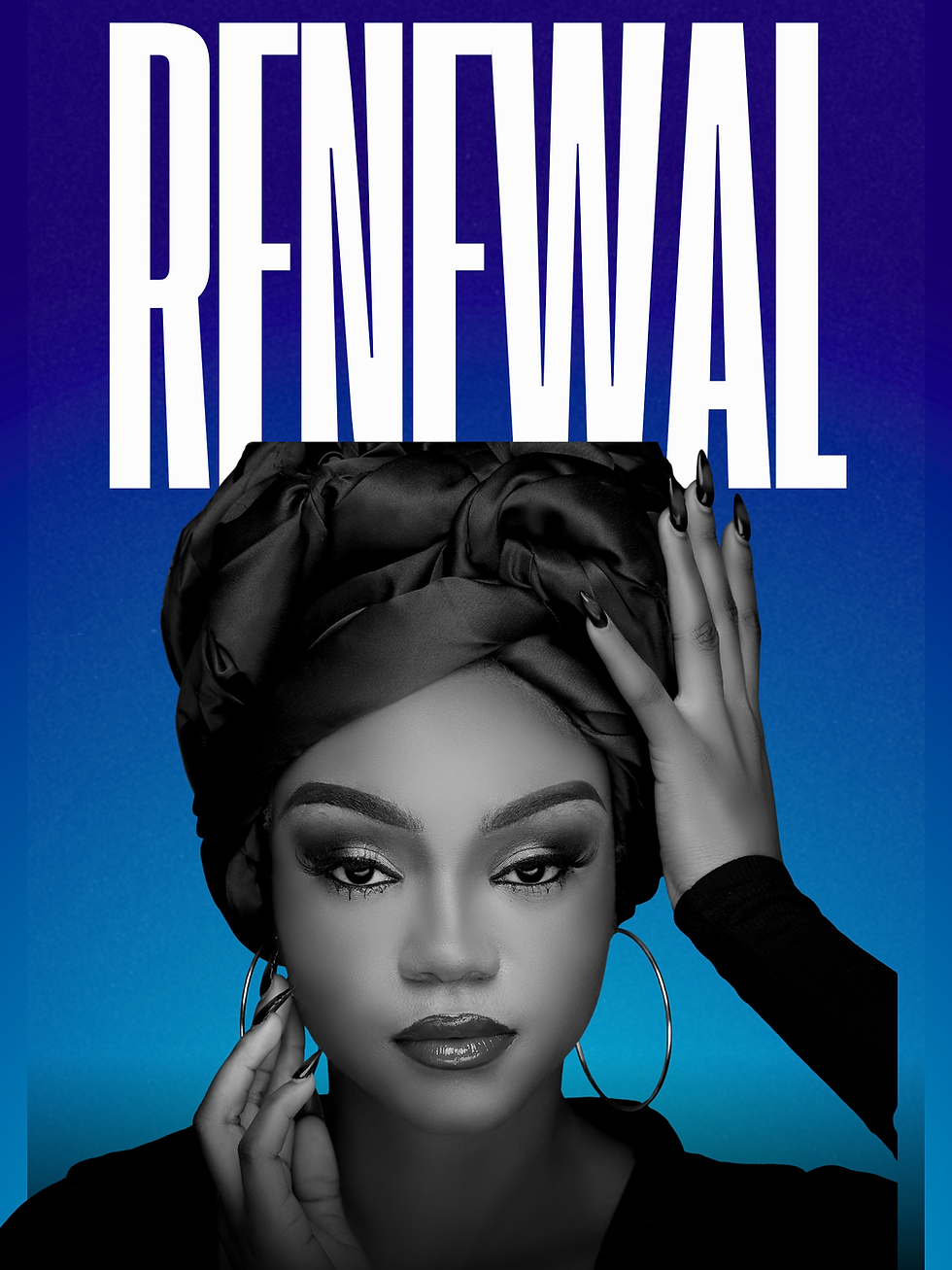
RENEWAL
A new year invites reflection, not on what we've lost, but on what we're becoming. This month's issue explores the beauty of starting over: the quiet courage to rebuild, the strength to forgive yourself, and the faith to believe that something greater still lies ahead.
Through interviews, personal writings, poems, prayers, journal reflections, and music, Renewal reminds us that healing isn't about erasing the past; it's about reclaiming it.
Theme of the Month
RE/CLAIMED

DECK:
Iman Abdallah Hadian walked into Mercy Correctional Facility to bring light, faith, and healing. What he encountered instead was a system that crushed the spirit of those it confines and those asked to serve inside it. His death was not an isolated tragedy, but a warning—one we cannot afford to ignore.
A Calling Met with Cruelty
Dawn had barely broken when Iman Abdallah Hadian stepped into Mercy Correctional Facility that December morning, not as just another staff member, but a spiritual guide entrusted with shepherding men through the darkest moments of their lives. He was trusted to walk into some of the darkest corridors of the prison and bring light where almost none existed. This was his calling, his purpose, and the role he carried with quiet dignity.
By 8:00 a.m., he was gone, dead by his own hand inside the superintendent’s office of the same prison where officers murdered Robert Brooks only months earlier. His death shook the walls, rattled the staff, and sent tremors through the incarcerated community. For a moment, the world looked. Then, as always, the world looked away. His suffering, his message, and his desperate final act were smothered by a culture trained to minimize tragedy whenever it comes from behind prison walls. But inside the prison walls, the impact lingered.
PULL QUOTE
“His final act was not weakness; it was a message. A warning. A truth the system could no longer bury.”
The Slaver Mindset: A Culture That Consumes Everyone Inside
America’s prison system operates under a culture many describe as the Slavery Mindset, a mindset that teaches us to ignore suffering, dismiss trauma, and normalize violence. It convinces the public that incarcerated people deserve whatever happens to them and conditions staff to believe their own pain is irrelevant. It even convinces spiritual leaders that their faith must bend to the institution. No training prepares a human being to carry God’s word into a place designed to break God’s creation.
Correctional officers, counselors, nurses, and chaplains all walk into the same morally poisonous environment each day, carrying Bibles, Qur’ans, prayer rugs, journals, healing words, and hope of helping someone rise above their circumstances. Instead, they are confronted with a machine that operates on punishment, fear, anger, humiliation, and silence. This system demands that everyone play a role, even when that role violates their personal values, moral code, and natural sense of humanity. Many leave each day wearing two identities: one created by the institution, and another held together only by love, faith, or ritual once they return home. To survive this imbalance, they live in emotional compartments, carrying burdens that often have no name. Iman Hadian lived inside that fracture every single day.
SIDEBAR: Understanding Moral Injury
Moral injury occurs when a person must witness, participate in, or stay silent about actions that violate their deepest values. It is a wound that affects the spirit as much as the mind. It often appears as emotional exhaustion, spiritual distress, guilt, internal conflict, and profound loss of purpose. It is common among soldiers, medical workers, and increasingly among correctional staff, but it remains almost entirely unaddressed inside American prisons.
The Spiritual Battle No One Saw Coming
Imagine waking up each day to serve the Highest while entering a system that destroys the very people you’re called to serve, where men begged for mercy and received punishment instead. Imagine reading scriptures about compassion while someone cries for help down a concrete corridor. Imagine offering forgiveness while knowing you watched a man being beaten on the floor only hours earlier. Imagine counseling someone on faith while the institution routinely violates the very principles you teach.
This is not ordinary work stress; this is spiritual injury. This is a moral conflict, a kind of internal war that leaves permanent marks on the soul. Those who knew Iman Hadian often said he was “stressed about work,” but that phrase cannot contain the truth of what he endured. He may have witnessed things no spiritual worker should ever see. He may have been pressed to limit prayers or religious services or ignore violations that directly contradicted both human rights and his faith. He may have gone home at night, pretending everything was fine while knowing the institution offered him no space to reconcile what he witnessed daily. That kind of tension crushes a man, not all at once, but slowly and painfully, from the inside out.
PULL QUOTE
“To survive, staff learn to split themselves in two, one identity for the prison, another for the people they love.”
The Day the Silence Broke
Some people break quietly. Some break privately. But Imam Hadian broke publicly, symbolically, and in the one place where the truth could not be hidden, the superintendent’s office. His death was not simply despair. It was truth made visible. It was a system exposing itself through the loss of a man who tried to hold it together with prayer, compassion, and faith. His final moments carried a message the institution refused to hear: the weight of this system is killing people on both sides of the bars. And yet, even with such a visible tragedy, nothing changed within weeks. No policy shift emerged. No serious statewide review was undertaken. No meaningful investigation into staff trauma occurred. His life, and the truth he revealed, were absorbed back into the silence that had long defined America’s prison culture.
What We Cannot Ignore
Iman Hadan’s final act forces us to confront a truth we have long avoided. A prison system built on silence will sacrifice both the confined and the staff who watch over them. His death was not an indictment of his strength, but of the institution that demanded he choose between his faith and his job, between compassion and conformity, between spiritual survival and moral collapse. This was not simply one man’s breaking point; it was a warning that the structure itself is breaking.
If we let this moment fade, if we return to business as usual, we participate in the same silence that consumed Iman. We must examine the trauma prisons impose on both incarcerated people and the staff who carry out institutional mandates. We must confront the culture of normalized brutality, the spiritual injuries endured by workers, and the moral contradictions embedded in every corner of the system. Ignoring these truths only ensures that another tragedy like this will come, and soon.
PULL QUOTE
“We owe him more than a moment of shock. We owe him the courage to face the truth: this system is killing people.”
A Call We Must Not Turn Away From
To honor Iman Hadian is not to mourn quietly; it is to act loudly. It is to question, to expose, to challenge, and to rebuild. Redemption is not just for those behind bars; it is for the system itself. Iman’s death demands a kind of courage we can no longer postpone. The cost of silence is too high, and the weight of this system is crushing too many souls to ignore.
Iman Hadian’s story is a reminder that even the brightest lights can be dimmed by environments built on harm. But it is also a reminder that truth, once spoken or embodied, is such a profound sacrifice that it can ignite movements, shift conversations, and change futures. We must decide whether we will let that truth fade or carry it forward and demand a system worthy of the human beings who walked within it.
Authored by Dr. David Z. Simpson
Author: Dr. David Z Simpson


Spotlight Interview
Hocus 45th
From Harlem to the Bronx, from pain to purpose, Hocus 45th ‘s story is one of rare transformation. Known to many as an artist, to others as a symbol of resilience, and to countless people as a mentor and movement builder. His journey reflects the power of a man who chose evolution over environment. After losing his father, his first guide into hip-hop, he turned to the streets for the belonging he desperately missed. That search led him into a world of violence, loss, and incarceration.


RE/CLAIMED: You often credit your father for introducing you to hip-hop. When you recall your early years, what part of your identity was shaped by that father-son bond?
HOCUS: My father always taught me to look a man in the eye when I speak. He was a serious man with deep integrity, and a lot of that rubbed off on me.
RE/CLAIMED: Before the world knew Hocus 45th, who were you as a young boy growing up in Harlem and the Bronx?
HOCUS: I was a video game freak growing up. I loved video games. If we had the internet back then, I probably would’ve been one of the best gamers in the world. I used to draw too. I even created my own comic books featuring characters I made up. I’ve always had a vivid imagination.
RE/CLAIMED: Losing your father so early was life-altering. Looking back, how did grief shape the choices you made afterward?
HOCUS: When my father died, it hit me hard. It left a massive void in my life, and I found myself yearning for that father-figure presence. Not long after he passed, I turned to the streets. I started selling drugs at 14. If he had been alive, I know I wouldn’t have gone down that path.
RE/CLAIMED: Many young men turn to the streets searching for family or protection. What were you searching for during that time?
HOCUS: My father always taught me to be a leader, not a follower. When he died, I felt the responsibility to make my own money and help lighten the load on my mother, especially with ten kids left behind. I knew she’d be focused on the younger ones, so I hit the streets to try to take care of myself.
RE/CLAIMED: You lived in two worlds, the music scene and the streets. What did each give you, and what did each take from you?
HOCUS: The street taught me how to hustle and survive, but it also took my innocence and exposed me to betrayal. Through all of that, music was the one thing that never left me. It was always my passion. I’ve always believed that when you pursue your passion, you eventually find your purpose, and music did that for me. But as much as it gave me direction, it also opened my eyes to the darker, shady side of the industry, a side I knew I didn’t want to be part of.
RE/CLAIMED: Despite everything happening around you, your passion for hip hop never faded. What did music represent for you at your lowest moments?
HOCUS: Without music, I don’t know where I’d be. Music was my way out of the streets; it represented hope. When 50 Cent co-signed a movement I created, it confirmed for me that music was what I was meant to be doing. I remember being 15, listening to DMX’s “Slippin,” feeling every word because that’s precisely where I was in life. I had no idea back then that he would one day become a close friend and mentor.
RE/CLAIMED: DMX played a meaningful role in your evolution. What is one lesson or piece of wisdom he left you with that continues to guide your life today?
HOCUS: DMX told me to get my passport because we were getting ready to go on tour overseas. I got it, but before we could go, he got locked up for about 90 days, so the trip never happened. When he came home, the first thing he asked me was whether I was writing and in the studio. I told him no, I had been dealing with a lot since he left, and honestly, I was making excuses. He looked at me and said, “Don’t ever stop making music. We’re going to make music until we die. Keep writing. Don’t ever stop.” That stuck with me. From that day forward, I vowed never to stop creating. He also told me that God told him to pass me the torch, that I was going to be a legend. Those words guide me every single day.
RE/CLAIMED: You've said that your time on Rikers Island sparked spiritual growth and deeper reflection. What shifted in your mindset during those years?
HOCUS: While I was on Rikers, I realized I had the creative ability to shape my own reality consciously. I started to understand who I truly am and tapped into my real power. I learned that I am not my circumstances. That shift changed everything for me. I began reading books that helped reshape my mindset – titles like Think and Grow Rich, The Alchemist, The Celestine Prophecy, and The Secret. Those books opened my mind and helped me realize that my life could be so much bigger than the environment I came from.
RE/CLAIMED: Transformation in prison is not easy. What inner battles did you have to confront to grow into the man you are now?
HOCUS: While I was incarcerated, I had to confront myself. Before coming home in 2012, I made a promise: if I made it out, I would share everything I had learned, the knowledge, the growth, the awakening with my people and with the same community I once helped destroy. I vowed to come back and be a part of the change. On 12/12/12, after two long months of trial, I was acquitted on all counts and finally set free. That moment wasn’t just freedom from a case; it was freedom from the mindset that once held me back.
RE/CLAIMED: How did your experiences reshape the message you wanted to bring through your music after your release?
HOCUS: Even after I came home, my music still carried pieces of my old lifestyles. I sprinkled that reality into my songs. Even though I made records like “Gun Control,” “Why Vegan,” and The New Pharaoh,” I was still creating gangster music too, because I knew that’s what would draw people in. My goal was to meet them where they were, bring them in with the sound they were familiar with, and then deliver the message I really wanted them to hear.
RE/CLAIMED: You said you felt called to a higher purpose. How did you discover that calling, and how do you stay aligned with it?
HOCUS: I discovered my purpose by going within, through meditation, reading, and doing the inner work. Changing my diet and becoming vegan also played a huge role in shifting my mindset. Discipline keeps me aligned. It keeps me rooted in who I’m supposed to be.
RE/CLAIMED: What moment inspired you to create the #DropMyFlagChallenge, and did you know it would touch as many lives as it has?
HOCUS: When I came home, I immediately started visiting schools and group homes to talk to troubled youth and help them avoid the mistakes I made. But every few months, we kept seeing huge RICO indictments with 20 or more people caught up in conspiracies. I knew we needed a real solution, something that would create distance between us and these RICOs.
The truth is, the gangs we represent are considered criminal organizations by the government. If we claim them, we stay connected to that world, and they will always find a way to pull us into those causes. So, I meditated on it and asked God for direction. What came to me was clear: it wasn’t enough for me to leave the gang privately; I had to leave publicly, and I had to lead my people out, too. That’s when I decided to drop my flag and launch the challenge.
Hocus 45th story reminds us that redemption is not a one-time event; it’s a continuous journey. Through music, mentorship, and movement building, he is rewriting narratives and creating pathways for others to follow. His life stands as proof that no matter where you begin, transformation is always within reach.
RE/CLAIMED: You’ve helped countless individuals walk away from gang life. What do you believe keeps so many people trapped in the cycle of gang life, and what is the best path out?
HOCUS: There are so many reasons people stay in gangs. For some, it feels like the only family they’ve ever had. Others get involved and later realize it’s not for them, but fear keeps them from leaving. And some want out, but don’t want to disappoint the people they grew up with. The truth is that the best path out starts with deciding for yourself. You must take back your life, your future, and your livelihood, and walk away from anything that doesn’t serve you or help you grow.
RE/CLAIMED: You’ve become a leader in your community. What does responsible leadership look like to you in this chapter of your journey?
HOCUS: For me, leadership starts with leading by example. I must be intentional about what I say and what I post publicly, because I know my influence is real and I never want to send mixed signals. I want young people to see that you can walk away from the streets, stay true to who you are, and still build a prosperous, productive life.
RE/CLAIMED: What do you hope young men see in you today that you didn’t know when you were their age?
HOCUS: I hope these young men see that it’s okay to change. I want to make discipline cool again. I want them to understand that protecting their community is cool again. Things like helping an elder with her bags, holding the door for someone, or playing a basketball game without a shootout, that’s the energy I want to bring back.
I want them to understand that you don’t have to be in a gang to be lit or to be respected. The streets brought me a lifetime of suffering. Even after stepping away, parts of it still haunt my life. I hope that they learn from my mistakes rather than repeat them. I do not want them to be like me, waiting until I’m over 40 to do things I should have done when I was 25. Don’t wait until life forces you to grow up. Be better than me and start now.
RE/CLAIMED: When you think about the years ahead, what legacy do you hope to leave behind?
HOCUS: I hope this movement outgrows me. Just as DMX passed the torch to me, I want to one day pass it on to others who will carry the message even further. We are all connected, one consciousness, sharing one experience. And at the core of that experience is service. My legacy, I hope, is empowering others to step into their purpose and serve their communities long after I’m gone.
RE/CLAIMED: If you could speak to the younger version of yourself, the boy before the pain, what would you tell him now?
HOCUS: I would always tell him to pursue his passion, even when it looks like nothing is happening, to keep going. Your passion is aligned with your purpose, and if you stay committed to it, you will eventually find your way. Never give up! You are more powerful than you can even imagine right now, and one day you’ll see it for yourself. And I’d leave him with a breadcrumb, something to guide him early: I’d give him the book The Secret.
RE/CLAIMED: How can people learn more about Hocus and the #DropMyFlagChallenge and get involved?
HOCUS: For anyone interested in learning more about the Drop My Flag Challenge, please follow our Instagram page @dropmyflagchallenge or my personal page @Hocus45th. If you’re interested in dropping your flag or considering it and need guidance or support, click the link in our Instagram bio to complete a private form we’ve created. The form collects your contact information to schedule a call with you.
RE/CLAIMED: We thank Hocus for sharing his story with RE/CLAIMED Magazine. His voice is a powerful reminder of the strength found in renewal and truth.
RE/CLAIMED Magazine Featured Interview